
Address
5th Floor, Zhonghuan Building, Weiyang Road, Xi’an, China
Phone
+86 182-9203-1134

Controlling boiler feed water quality is essential to prevent scaling, corrosion, and salt deposition inside boilers. Poor water quality can significantly reduce boiler efficiency, damage equipment, and increase maintenance costs.
In general, low-pressure boilers can use softened water as feed water, while medium and high-pressure boilers must use demineralized water or deionized water as boiler feed water.
Di Ao provides complete boiler feed water treatment systems including reverse osmosis systems, EDI systems, and mixed bed polishing systems to ensure high-quality boiler feed water.
Boiler feed water quality must meet national or industry boiler water standards such as:
These standards apply to low, medium, and high-pressure boiler feed water systems.
For power plant boilers, ultrapure water with conductivity corresponding to 0.5 – 10 MΩ·cm resistivity is typically required.
High-purity water ensures:
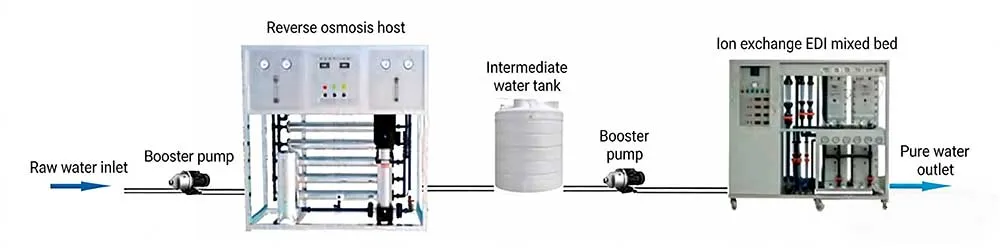
This process can effectively remove:
The system ensures stable high-purity water for boiler operation.
EDI (Electrodeionization) is a continuous electric desalination technology that combines ion exchange resins, ion exchange membranes, and electrolysis technology to continuously remove ions from water.
EDI systems can produce high-purity water with resistivity up to 15 MΩ·cm or higher.
Advantages of EDI systems:
If reverse osmosis is used before EDI, the conductivity of RO permeate is typically below 10 μS/cm, which is suitable for EDI feed water.
Mixed bed ion exchange systems (also called polishing mixed bed) are usually installed at the end of the water treatment process to further improve water purity.
Mixed bed systems use cation and anion exchange resins to remove remaining ions from water, producing ultrapure water with resistivity up to 18 MΩ·cm.
Mixed bed systems are typically used in:
Although mixed bed systems require resin regeneration, they can produce very high-purity water.
We provide complete boiler water treatment solutions including:

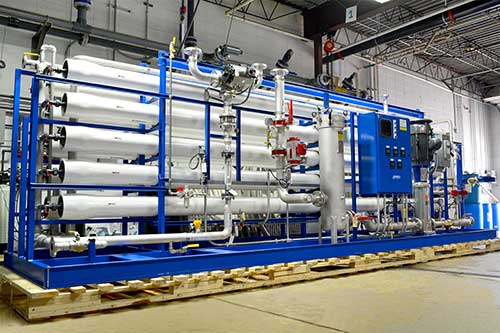
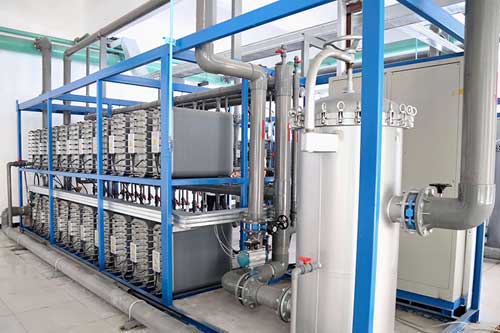

Contact Di Ao Water Treatment for professional boiler water treatment solutions. Our engineering team will provide customized treatment programs to prevent scaling, corrosion, and fouling, tailored to your boiler system and project requirements.
Contact Di Ao today for:
👉 Contact Us Now